
Visiting Hisaishi
The origins of life, Honest Abe's vaccines, MAGA Steak 'n Shake, Joe Hisaishi conducts, and the pursuit of greatness.

Joe Hisaishi, famed Japanese composer behind the soundtracks of twelve beloved Studio Ghibli films1, was to conduct the Chicago Symphony Orchestra on April 23, 2026, in a two-hour performance of his selected works. Tickets ranged upon release from $85 per person to several hundred dollars per person. I needed two, live nowhere near Chicago, and do not have a job, all of which meant that this financial range spanned from “reckless” to “delusional.” I held my nose and bought two of the cheapest available seats.
There are very few truly great artists alive at any given time. It is always worth your trouble to see them, especially if you admired their work before knowing they were great.
I made this and other rhetorically effective rationalizations, several months tumbled past, and my wife and I set out toward Chicago. The drive from Tennessee is about eight hours. We left early in the morning so as to make the most of the one-night trip; we wanted to avoid the need for in-vehicle fumbling out of sweatpants and into orchestra-appropriate attire, align with the hotel’s 3 p.m. check-in time, and grab dinner somewhere in the city before the performance.
We listened to a podcast on the way about the origins of life in which a panel of three highly credentialed and rational-seeming people made the case for an intelligent designer (God). A mathematician, a philosopher of science, and a chemist walk into a bar, figure out each of the others is a Christian, and conclude that the bar must actually be a Hoover Institution media property. I found most of the discussion convincing, though I am hardly a skeptical audience.
They at one point played an audio clip of the below 1995 Carl Sagan quote:
Here we are like mites on a plum, and the plum is this little planet and it goes around an insignificant local star, the sun. And that star is on the obscure outskirts of an ordinary galaxy, the Milky Way, which contains 400 billion other stars. And this galaxy is just one of something like 100 billion other galaxies that make up the universe. And it is now beginning to look, this universe is one of an enormous number, maybe even an infinite number of other closed off universes. So the idea that we are central, that we are the reason there is a universe is pathetic.
This somehow led into a lengthy discussion amongst the host and panel trio about the Miller-Urey experiment and its explanatory shortcomings, which then morphed into a broader consideration and explication of the cell’s inestimable complexity.
The podcast ended, and I felt that Carl Sagan’s declaration of human centrality as a “pathetic” notion needed a more direct address. I posited to my wife that Sagan was making indefensible determinations of significance, or lack thereof, and that he understood neither the nature of God nor of humanity. Why is the sun “insignificant,” or the Milky Way “ordinary”? As far as we know, the Milky Way is the only galaxy that contains any life whatsoever, life that is impossible without that “insignificant local star.” Is God unable to alchemize things deemed ordinary, or even broken, for His divine purposes? Many say He has a penchant for exactly this.
Sagan’s reasoning requires the same hubris that it seeks to attack: his argument hinges on giving credence to the assumption that humanity’s importance implies spatial centrality, that a God would place us not just at the center of our solar system, or of our galaxy, but of the literal universe. This is a comical and quintessentially human arrogance. God says to Adam, “You are dust, and to dust you shall return.” He overwhelms Job with rhetorical questions about Creation, to which the man wisely responds, “I lay my hand on my mouth.” It is, actually, very funny and appropriately humbling for God to situate us on a fringe cosmic speck knowing that we would naturally assume — and later disprove — our physical centrality.
My wife pointed out that humans are very important to God and that it wasn’t so unreasonable to assume that the sun would revolve around the Earth. I conceded that I was victim to my own brand of modern hubris.
We passed an Abraham Lincoln-themed vaccine advertisement at the Illinois border that said, “Lincoln didn’t have the opportunity to get vaccinated, but you do!” This seemed like a non sequitur to me, since Lincoln was shot in the back of the head at the theater, a condition we have not yet developed an immunization for.2 I initially read the sign as “Lincoln didn’t have to get vaccinated, but you do!” which made more advertising sense and also fit the general lean of extant billboard content. The canvas behind Honest Abe’s outline was a pale blue paper that reminded me of surgical masks.
I later conducted further research, figuring that I might be missing an explanatory piece of Lincoln’s history, only to find that he got smallpox sixty-seven years after the invention of the smallpox vaccine (which he did not receive, for reasons unknown) and was ghastly ill during his renowned 1863 Gettysburg Address.
My wife (formerly a Brit) did not know that Lincoln had been assassinated or why he was featured on the Illinois border. I told her that some people think Lincoln was gay, and that his wife Mary Todd was a shrew. She found my comments neither relevant nor enlightening.
We decided to stop for lunch at Steak ‘n Shake, a staple franchise of my adolescent life in the Midwest and to which my wife had never been. My only recent exposure to the brand before pulling into this hilltop Indiana location was a faint, peripheral memory of its magnate owner latching onto a three-headed MAGA / Bitcoin / MAHA resurrection strategy. Riding the mercurial bull of cultural zeitgeist is risky business. There were only two other people in the restaurant, neither of whom turned out to be customers.
I remembered Steak ‘n Shake as a lively dine-in spot themed like a 1960s burger joint. It still had checkered wall tiles and retro illustrations of bob-haired carhops, but the front-of-house staff had been replaced by two large portrait-oriented touchscreens that stood atop the main counter. I was tempted to order the Bitcoin Steakburger, the top bun of which is stamped with the currency’s B symbol, but ultimately passed on both that and the Patriot Milkshake (red white and blue sprinkles, plastic American flag with toothpick flagpole, and dark chocolate Statue of Liberty figurine topper).
My wife ordered a Small soda and was automatically provided a QR code printed on receipt paper. This was to be scanned underneath a laser light apparatus that looked like a thin-necked sink faucet, ostensibly to release some mechanical lock on the correct stack of nested empty soda fountain cups. The scanner didn’t appear to have any effect; none of the cups were locked, in any case.
The lone other couple in the restaurant was seated across from us in a booth against the back wall: a somewhat haggard and round blonde woman in her fifties and a tall, well-built black man with an afro-puff ponytail who wore cargo shorts and looked to be at least twenty years her junior. There were seven or eight large plush animals sitting on their table, presumably won from the adjacent Crazy Claw machine. The Claw King repeatedly got up and stood behind the woman’s booth seat to whisper in her ear and stroke or massage various parts of her upper body. The woman disappeared at some point during our meal, returning in customary middle-managerial uniform (too-tight khakis and a polo) to sit across from a much younger woman and conduct what we guessed was a Steak ‘n Shake job interview. The relationship situation felt like a low-tier sugar mama and sugar baby arrangement, though uncertain financial incentives cast doubt on this theory.
Our food wasn’t half bad. I went to the bathroom before getting back on the road and spent a good fifteen seconds examining and waving my hands in front of the wall-mounted soap dispenser, which turned out to be the manual push kind as opposed to the automatic sensor kind, and I remember thinking that this must have looked like a strange inversion of the “Neanderthal prods iPhone with a stick” trope.
Several hours later — having made it to Chicago, checked into our hotel, grabbed deli sandwiches, and donned formal attire — we hailed an Uber to Symphony Center.
The building that houses Orchestra Hall doesn’t look like much from the outside; it is a rectangular brick and stone structure that could be easily mistaken for a historic high-end condominium complex if not for the Chicago Symphony Orchestra banners and etched composer names that sit above its trio of large arched windows and Juliet balconies (Bach, Mozart, Beethoven, Schubert, Wagner). The preponderance of My Neighbor Totoro and Spirited Away accessories in the milling crowd confirmed that we were in the right place.
Vested ticket takers scanned us through to a classic-theater-esque lobby with white walls and red carpet. It felt ornate but also sort of empty. I knew going in that our seats were not exactly primo, but there was something comical about following the Upper Gallery signs through a set of five or six different landings, each with its own rise and fall of false promise that sent us up increasingly labyrinthine sets of staircases whose walls and ceilings compressed tighter and tighter inward until the final flight was so claustrophobic and dimly lit that one could imagine it leading to an attic.
It instead opened up into another, lower-ceilinged white and red lobby area with a concession bar selling drinks to the vertically banished underclass. There was a floor sign listing the available beverages and explaining that drinks were only allowed into the Hall when paired with the purchase of a souvenir cup. Neither my wife nor I drink, but we decided to try a couple of mocktails (the Phony Negroni and Spicy Paloma, if memory serves).
The ordering process turned into an Abbott and Costello sketch when the bartender informed us that one or both of these drinks could not be paired with the necessary adult souvenir sippy cups for unclear bureaucratic reasons, which led to a back-and-forth about which non-alcoholic options met sippy cup regulations, triggering a collective realization that the floor menu had in any case been outdated and needed to be refreshed with tonight’s menu, an exchange the bartender somehow took as an indication that we wanted to forgo purchasing the souvenir cup required for Hall entry. We eventually paid $19.76 and received one small lidded cup half-filled with non-alcoholic bubbly pink rosé (which was pretty good, actually, by my estimation, though I have never had real rosé).
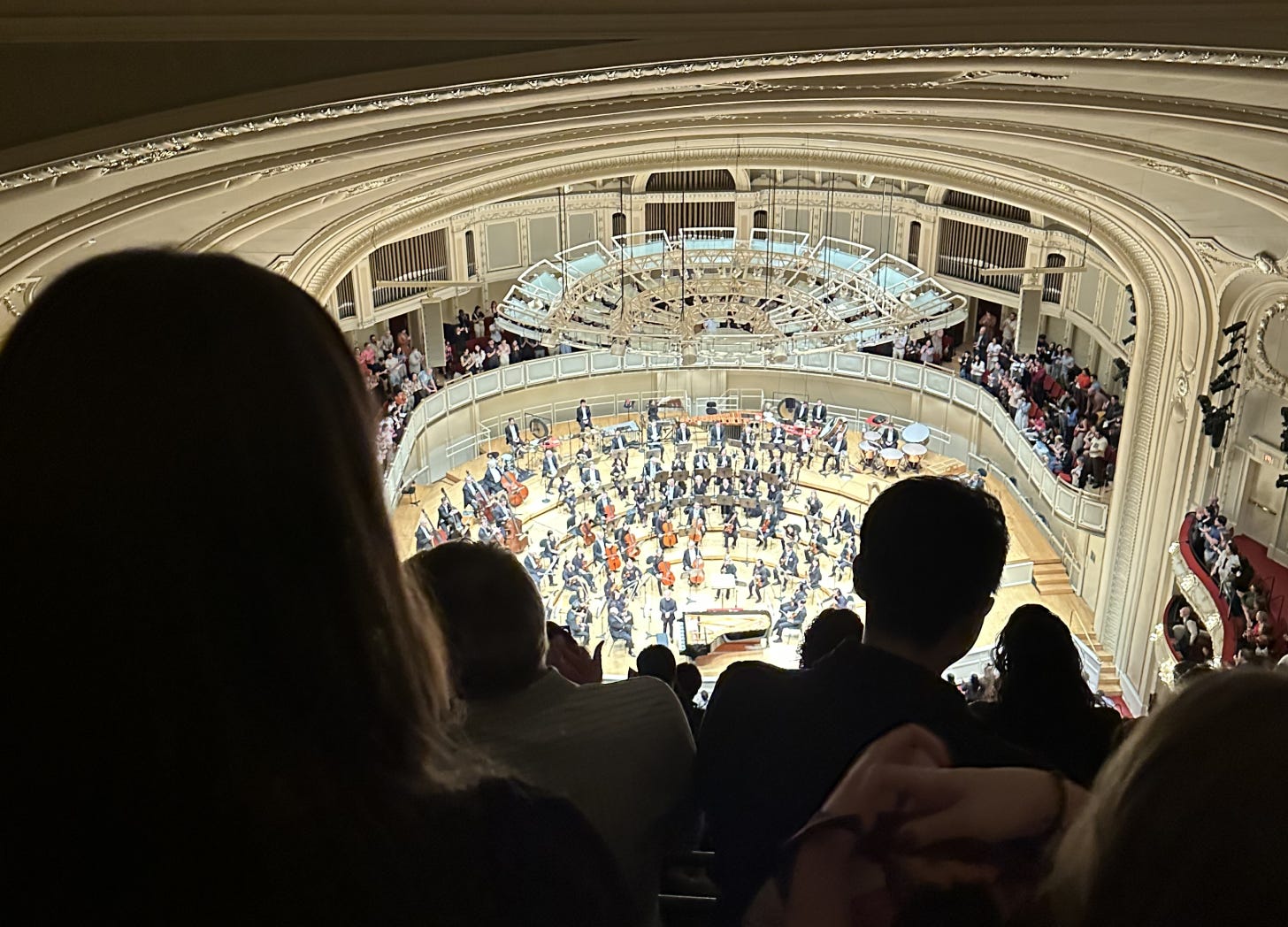
We made our way to our seats, which were in the last row of the theater’s most distant and steeply raked terrace. This last-row positioning gave us a unique advantage over the rest of our nosebleed-section neighbors, as we were situated against the back wall and could stand up without obscuring anyone’s vision. It was a strange experience being one of the only people in a venue of 2,500 to be standing, and it occurred to me that I had never had a similar opportunity. We were on the fringes, curled high up and resting mid-bloom on the petal tip of some great unfolding lotus.
The Orchestra Hall itself was phenomenally beautiful. It felt vast and open, domed and ornate, composed of nested curves and arches and waves such that everything in the construction seemed to fall toward the gravity well of its center stage. The acoustic canopy suspended over the orchestral players looked like a sidereal chandelier, or a giant floating manta ray.
I read the usher-provided glossy informational pamphlet while waiting for the show to begin and learned that “Joe Hisaishi” is a stage name derived from the Japanese pronunciation of “Quincy Jones,” the pop superproducer behind numerous hit Michael Jackson records (Thriller, Bad, Off the Wall, &c.). This origin is surprising from a genre perspective, but greatness recognizes itself across such boundaries without much trouble. The pamphlet also stated that Hisaishi had “nearly forty solo albums and over a hundred film scores to his credit.” He was seventy-five years old.
These numbers rang in my head as the lights darkened and principal members of the orchestra began walking onstage to customary applause. The concertmaster, i.e. first-chair violinist, cued the orchestra to begin tuning and then sat down. I stood up, unfamiliar with any of the orchestral concert protocols but reasonably inferring from the dimming and tuning that the conductor would be walking out soon. I wanted to be able to see him when he did. This was the reason I had come here, really: to lay eyes on someone who I felt was truly great at what they did, to be in the same room as them, to see if there was something I could learn by looking directly at them; studying, desperate to discover what made him different from me, wanting to be imparted with some lesson or piece of wisdom that could only be absorbed in person and that would put me on my own path to being great in some way. I was certain that there was something vitally important about being physically exposed to Greatness and intently focusing on the person who had managed to harness it.
Joe Hisaishi appeared from stage right and the crowd erupted. He looked to be wearing an all-black gakuran-style conductor’s jacket, though the details were impossible to make out from my far-off perch. He waved and bowed several times while waiting for the deafening applause to die down, smiling, his mannerisms bashful and endearing and altogether very Japanese. There were at least a few isolated whooping sounds from enthusiastic patrons. My wife later described Hisaishi as really cute, in the old-man sort of way. A hush eventually swept over the crowd, and they began.
The sound was magnificent. He bounced with childlike earnestness through playful stanzas, his enjoyment palpable; he desperately willed cellists and double bassists through dark straits heavy with somber mist, tracked and kept in measure the chaotic upper layer of running string arpeggios and flute polyrhythms and vibraphone riffs that always seemed to narrowly avoid collision. It was timeless; it was universal.
I stared as hard as I could at this man, willing my eyesight to improve through sheer muscling of whatever internal squeezing mechanism brings distant items into focus. I bore a hole into the back of his head with my eyeballs. I didn’t dare to blink. It was obvious that he was great; I could feel it, everyone in the room could feel it, that what was happening here was great and that this wonderful arrangement of notes was funneled from the divine through his imagination — the imagination of this man standing here at the front, who was vigorously swinging his arms around, who had created the incredible works that were being brought to life in real time by the orchestra.
As I watched and listened, I thought over and over about those numbers: Forty solo albums. One hundred film scores. Seventy-five years of being alive. I imagined what it must take to write a single orchestral phrase, to revise it to perfection, to arrange a cohesive movement, to score a one-hour-and-forty-one-minute film3, a dozen of them, a hundred of them. Years upon years of dedication, decades of toil, an endless pursuit of improvement.
The pamphlet stated that Joe Hisaishi, real name 藤澤 守4, had once said, “in my life, I just want to make music that can make people happy and escape.” My heart sank, and envy reared within me, because my desire to be great was unmoored. It was empty, it was non-specific. I wanted what he had — not to write symphonies or conduct orchestras, but to have clarity of purpose, a single-minded desire behind which I could throw the entirety of my life’s vigor, something that I knew I loved doing and was uniquely suited to becoming great at, that would wring from my existence whatever essence of truth God had tasked me with bearing into the world.
The music eventually stopped and I allowed myself to blink and the well of tears that I had built up through brute staring rushed down my face.
— G. B. Rango
Technically eleven, since Nausicaä of the Valley of the Wind was released a year before the official creation of Studio Ghibli, but twelve is true in spirit.
I am leaving the obvious “shot” pun to the reader.
Ponyo.
Mamoru Fujisawa.